
What happened (short and snarky)
Heads up: a security researcher released working exploit code for four Linux kernel bugs that let a local account escalate to full admin privileges — yes, public exploit code. The researcher, Asim Manizada, privately reported the issues, vendors pushed fixes, and then the exploit details went live. If your machine runs an updated kernel from your distro, breathe easy. If not, move fast.
The exploits are real code: tuned to specific kernel builds, likely to crash things, and so far seen only in lab tests. That said, making exploit code public always raises the odds someone will weaponize it against shared servers, multi-user hosts, or any system where an attacker already has a foot in the door.
The bugs, the weirdness, and why they matter
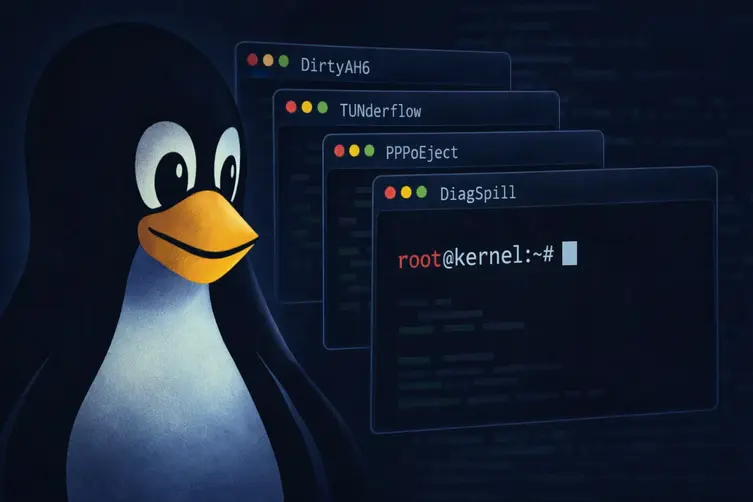
There are four distinct networking-related kernel flaws involved. Each is a memory-safety issue that lets an attacker corrupt kernel memory and potentially get a root shell. Short descriptions:
- DirtyAH6 — an IPsec/IPv6 handling bug where a routing-header field was trusted incorrectly, letting a crafted packet write past a buffer.
- TUNderflow — a TUN/TAP virtual device sizing error that causes a wraparound and ends up placing packet data outside its intended buffer.
- PPPoEject — a PPPoE use-after-free where code kept a pointer into a network buffer while a routine could free or move it, then later wrote to freed memory.
- DiagSpill — an SCTP reporting bug where a 16-bit counter wraps at 65,536 endpoints, causing a massive copy that overruns the buffer by megabytes.
Three of the four require unprivileged user namespaces to be enabled for an ordinary user to reach the network privileges they exploit; the DiagSpill problem is the exception and can be triggered without user namespaces if the SCTP module and certain options are present. Two of the issues (DirtyAH6 and DiagSpill) can also crash systems from the network in narrow configurations, but remote root is either very hard or not seen in practice.
Interesting side note: the researcher used an AI-assisted process to map kernel memory handling — the fixes even credit that tooling. Welcome to modern bug hunting, where models and humans tag-team kernel mysteries.
Which kernels carry the fixes? The mainline kernel versions that first include all four patches are:
- 5.10.270
- 5.15.221
- 6.1.188
- 6.6.157
- 6.12.109
- 6.18.50
- 7.2.4
Note: most users consume kernels from their distribution (Debian, Ubuntu, Red Hat, SUSE, etc.), which apply fixes on their own timetable and may use different version numbers. Check your distribution’s security advisory to confirm the fixes are included.
What you should do right now
Short checklist — patching is the right move, but if you can’t patch immediately, these steps reduce risk:
- Install the kernel update from your distribution that contains the fixes listed above. This is the best, recommended approach.
- If you can’t patch yet: disable unprivileged user namespaces to stop ordinary accounts from reaching three of the bugs (DirtyAH6, TUNderflow, PPPoEject). This doesn’t help for DiagSpill or processes that already have network-admin rights.
- Turn off networking features you don’t need: AH6 (IPv6 IPsec AH in transport mode), TUN/TAP, PPPoE, and SCTP. If you don’t use them, disabling them reduces attack surface.
Keep in mind the researcher recommends patching rather than broad feature removal: other attack paths might exist, and fixes are the durable solution.
Extra context: the exploit code is tuned, can crash systems, and so far hasn’t been reported in the wild. But on multi-user machines, cloud instances, or containers, local privilege escalation is dangerous — an attacker who already has a low-rights foothold could escalate to complete control.
If you like digging deeper, the researcher published a technical write-up and working exploits after coordinated disclosure with distributors. If you’re using this for testing, do it in isolated lab environments — these exploits can destabilize hosts.
Bottom line: update your kernel when your distro ships the patches, or take the quick mitigations above until you can. Then get coffee and maybe hug your nearest, non-compromised server.