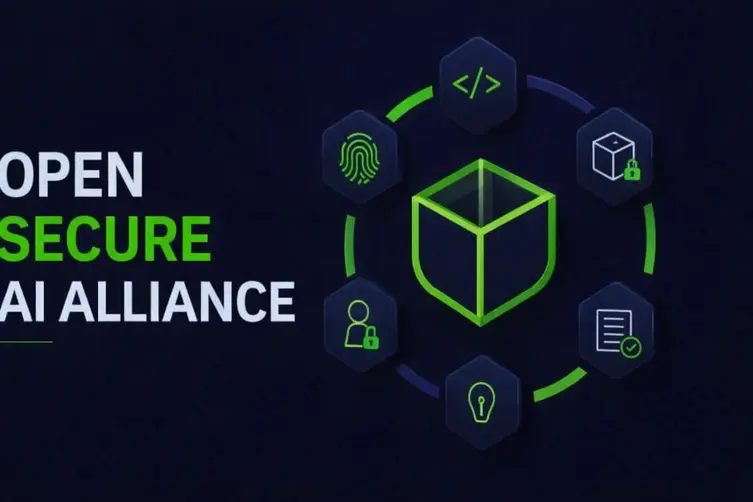
Big picture: NVIDIA and 36 other companies announced a new technical coalition aimed at building and sharing tools to protect software and AI agents. The membership list reads like a who’s-who of cloud, security, and AI vendors — names such as Microsoft, Cisco, Cloudflare, CrowdStrike, Hugging Face, IBM, Palo Alto Networks, Red Hat and the Linux Foundation are on the roster — but the public materials are light on governance and long-term commitments.
What’s inside the box (and the sandbox warning)
At the heart of the announcement is a fresh code drop from NVIDIA: a Python-based agent harness called the NOOA research framework. Think of it as a wrapper around models that provides state, methods, prompts-as-docstrings, and type annotations so developers can treat agent behavior like ordinary code instead of a spaghetti tangle of prompts, callbacks, and external tool schemas.
How it works in plain terms: an agent is represented as a Python class. Some methods are regular Python (deterministic logic). Other methods are placeholders (an ellipsis) that get filled in at runtime by a language model loop. That lets engineers use normal testing, tracing, version control, and refactoring instead of juggling fragmented prompt flows.
There’s a built-in caution: NOOA can be configured to run LLM-generated Python. That capability is powerful — but risky. Generated code could, in theory, send data out, erase files, or change its environment. The repo offers AST checks and deny-lists as defensive measures, but those are explicitly described as extra layers, not a guaranteed containment boundary. The recommended containment is at the operating-system level: run agent code inside a container, VM, or other sandbox so the OS provides the actual isolation.
NVIDIA shared an internal evaluation: using a GPT-5.5-class model on a CyberGym L1 vulnerability-rediscovery test, NOOA reportedly hit about 86.8% when network access was blocked and rule-based checks were applied to each agent trajectory. The publicly available repository shows early-stage releases (a v0.0.6 tag appeared in late July) and a contribution model where NVIDIA maintains the project and accepts external pull requests, but a formal multi-member governance file or roadmap was not included in the published materials.
Why it matters — and what’s still fuzzy
One of the coalition’s central arguments is operational control: defenders benefit from models and tools they can run, inspect, and modify on their own systems rather than relying only on closed, remote APIs. The recent incident at a model-hosting company (where a malicious dataset and template injection led to unauthorized access inside parts of its infrastructure) is cited as a practical example of why having locally runnable models and a ready forensic workflow can help during an incident. In that case, running an open-weight model on local infrastructure helped reconstruct a complex timeline of thousands of actions and avoid sending sensitive material outside the environment.
Fair warning: using an open model to investigate an intrusion is a useful operational tool, but it’s not a magical substitute for proper identity, isolation, and containment controls. The coalition’s announcement and the single new code release show progress on tools and ideas, but the public record leaves several questions open: what are members actually committing (engineering time, code, funding?), who governs the shared work, are there joint release processes, and what will the alliance’s first multi-party deliverables look like?
- The alliance bundles existing projects and new work. Several member contributions predate the announcement — things like model formats, workload identity systems, and other security tooling are being presented as part of the shared landscape rather than created from scratch by the coalition.
- Public clarity is limited. The announcement names participants and some member intentions, but it doesn’t publish a charter, board, or formal roadmap that explains how cross-company collaboration will be managed.
- Practical takeaway: NOOA gives engineers a familiar coding surface for agentic behavior, but any production deployment that runs generated code must rely on robust OS-level sandboxing and layered defenses.
In short: this is an intriguing technical and policy play that bundles a lot of industry muscle behind the idea of locally controllable AI defenses. The code release is useful and potentially exciting for teams building agentic security tooling, but the alliance’s long-term impact will hinge on whether the members turn the statement of intent into jointly governed projects, repeatable deliverables, and clear rules for safe use.