
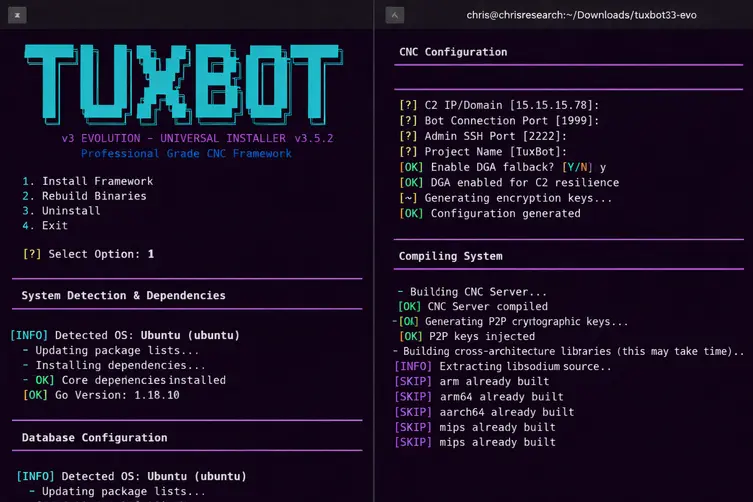
Meet TuxBot v3 Evolution — a Frankenstein-ish Internet-of-Things botnet framework that reads like a developer’s late-night side project… with AI copilots and the occasional facepalm. Researchers found a partly working, multi-component toolkit that appears to have been assisted by an LLM, left with rough edges, and shipped with evidence of the LLM’s own internal chatter still stuck in the source.
Inside TuxBot v3 Evolution
Under the hood, TuxBot is a modular mess of goodies and half-finished genius. It bundles a C-based agent that’s cross-compiled for numerous CPU types, a Go-written command-and-control (C2) server with a DDoS panel, a custom exploit virtual machine for trying device flaws, Docker test infrastructure, and an automated build pipeline. The author stitched in parts from older IoT botnets and open-source DDoS tools, then let an LLM help port and generate code.
- Supported architectures: ARM, MIPS, MIPSEL, MIPS64, x86_64, PowerPC, and RISC-V.
- Attack and management pieces include scanners, a SOCKS5 proxy, a miner placeholder, and multiple DDoS modules.
- It tries Telnet credential pairs from a list of 1,496 combos to brute-force devices, and also plugs in exploit code for 30+ IoT families.
- Comms: primary encrypted TCP channel plus a SHA512-based domain generation algorithm (DGA), P2P gossip with Ed25519-signed commands, IRC, DNS TXT lookups, and HTTP polling as a fallback.
The Go C2 listens on multiple ports for different purposes:
- TCP port 1999 (or 31337): encrypted command dispatch.
- TCP port 2222: operator interactive shell (SSH-style).
- TCP port 9999: JSON API for programmatic control.
Why the AI Twist Is Weird (and Dangerous)
Here’s the part that makes you both amused and uneasy: the LLM actually wrote bits of the botnet, but not perfectly. The code contained fragments of the AI’s chain-of-thought — basically the LLM talking to itself inside comments — and even a safety disclaimer that the developer forgot to remove before shipping. Some features in the collected samples simply didn’t work, which suggests the LLM produced plausible-looking but buggy code in places.
- Initialization steps observed include loading C2 addresses from a multi-tier system, enabling anti-debug and anti-VM checks, renaming or hiding processes, installing persistence mechanisms, and spawning submodules for scanning and attacks.
- Persistence techniques: systemd services, cron entries, and a watchdog keepalive process to keep the bot alive on infected machines.
- The HTTP scanner can juggle up to 128 concurrent connections to hunt for vulnerable web interfaces.
Unit 42’s analysis notes that a manual code review would have fixed many of the bugs. That’s the scary part: a little polish and this could become a much more capable toolkit. There are also signs of shared infrastructure and code overlap with other IoT malwares, placing the operator in a broader ecosystem of botnet operators.
If the botnet matures, expect faster feature addition and a single developer pulling off what used to need a small team: multiple C2 channels, a modular exploit framework, and a DDoS-for-hire panel — all powered, at least in part, by AI-generated code.
encrypted C2 channel and DGA features show the intent to evade takedowns and detection, even if some mechanics are still brittle in this edition.
Quick Takeaways & How to Protect Yourself
- Patch your devices and update firmware regularly — many IoT hacks exploit known, unpatched vulnerabilities.
- Turn off Telnet and other legacy services if you don’t need them; change default passwords and use strong credentials.
- Monitor unusual outbound connections, especially to odd ports or many DNS lookups that could indicate DGA activity.
- Segment IoT devices on separate networks and limit their internet access to reduce blast radius.
In short: TuxBot v3 Evolution is a work-in-progress that offers a peek at how AI can speed up malware development — sometimes clumsily, sometimes dangerously. Treat your devices like gossiping houseplants: keep them updated, don’t give strangers the keys, and watch for weird behavior.